Thursday, December 6, 2012

Holiday Exhibit of my work...

"HOT to TROT" 12 x 16, Oil on linen panel.
"STANDING GUARD" 20 x 24" Oil on Linen

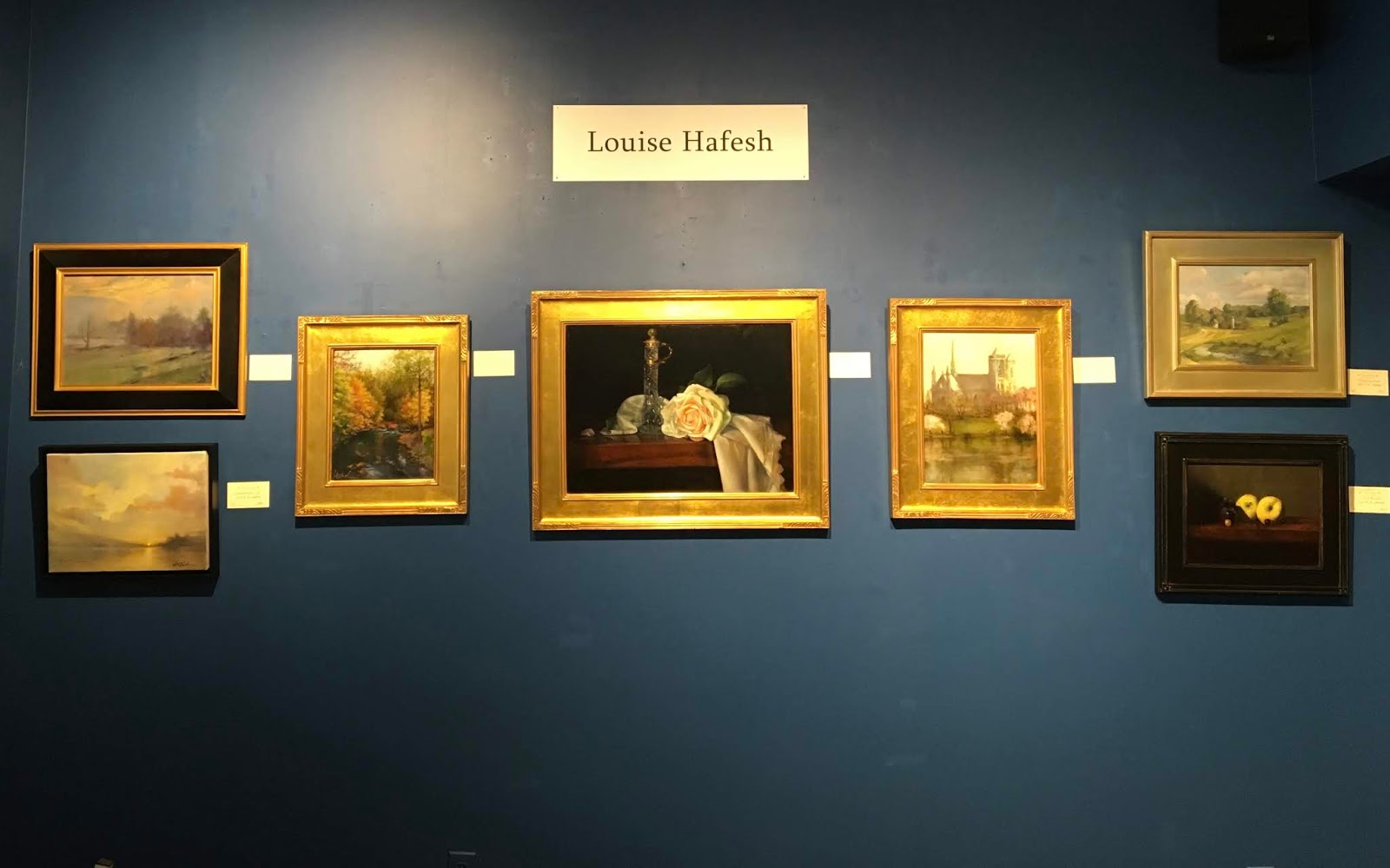
Jewel Spiegel Gallery will hold a special holiday exhibit  from 1 p.m. - 5 p.m., Saturday December 8, 2012. 10 of my paintings, including "Hot to Trot" and "Standing Guard," will be on display. All are welcome. Address: 30 N. Dean Street, Englewood, NJ  201/871-3577.

Thursday, November 29, 2012

A brush with History...

A sampling of Kinstler's sketches and portraits grace his studio at the National 
Arts Club in New York City.  He has painted more than 50 U.S. Cabinet 
members, seven U.S. presidents and countless celebrities and business leaders.
One week after Everett Raymond Kinstler's successful March 2012 opening of his Pulps to Portraits exhibit at the Norman Rockwell Museum in Stockbridge Massachsetts, I had the opportunity to interview the master portrait painter at his Grammercy Park studio in Manhattan. 

Still riding high from the celebration of a 70-year career that has taken him from an inker's apprentice to illustrating books and magazines to painting over 2000 portraits of a veritable who's who in the world, the artist/teacher shared some intriguing anecdotes about the joys of being a painter of people. 

The January/February issue of the Artist's Magazine includes the full article (8-pages) and highlights some of Kinstler's celebrated portraits of such luminaries as: Tom Wolfe, John Wayne, Christopher Plummer, to name but a few. 
.
I took this long shot of Kinstler's studio, which was once occupied by the
artist's early mentor, Frank Vincent DuMond, an American Impressionist
painter and prominent teacher. 

Tuesday, October 2, 2012

Just off the Easel

"BREAKFAST with SABRINA"  9 x 12 Oil on Linen
A presentation of my latest painting
 took place at Design Domaine Gallery,
 Bernardsville, New Jersey 

Just off the easel...  my latest commission through Design Domaine Gallery, which  is on its way home with my newest patrons.

Working from a treasured family photo of grandfather and granddaughter, I was inspired by the intensity and intimacy of the scene.

The real standout, though, was the beautiful stream of light that cut across the young girl's body, placing a glorious glow on her face before connecting with her grandfather's arm and side pocket then settling on a portion of the table. 'Twas both a joy and a challenge to paint!

Tuesday, September 4, 2012

"Magical Night" chosen as cover of new Vivaldi CD


"MAGICAL NIGHT" Oil on Linen. 16 x 16
Thrilled to announce that my painting, "Magical Night" was chosen for the cover of a new Vivaldi CD entitled, "Venetian Dreams.” This latest Bridge Records' offering features Rebel, a New York-based Baroque ensemble that has been hailed by the New York Times as "sophisticated and beguiling." 

The 16 x16 painting is one of a four mask series that I included in my "For love of Venice" exhibit. Along with a sample of the CD and eight of my other paintings,  it is now on display at Design Domain Gallery, 67 Mine Brook Road (Route 202), Bernardsville, New Jersey.


Tuesday, July 24, 2012

Creating the Soul of a Vision!


I well remember a Van Gogh exhibit that I attended back in college, and in particular, his painting entitled, "Pair of  Shoes"(1886.)  Van Gogh's work often expressed sentiments that he felt about his subjects, and in this depiction of a workman's well-worn, seasoned boots conveyed a moving portrait of their owner. Transcending a simple arrangement of inanimate objects, this painting communicated much more--a sense of family, belonging, humility, character, and perseverance—human qualities.

"Pair of Old Shoes" Vincent van Gogh
I recalled “Old Shoes” again today when a talented artist friend (Kate) asked me to critique some of her newest work. It happened to be a series featuring shoes—all types, from work to casual to dancing, and each painting spoke volumes about the people who wore them.

Kate wondered whether she had become a little obsessive about her theme, and that got me to thinking about the role of theme in art. As a writer, I aim to weave it into a piece in such a way that the characters or subjects, the setting, storyline, events, direct the readers to interpret a theme for themselves.  Similarly, art presents the same challenge; accomplished through composition, lighting, color, brushwork, etc., and it’s always gratifying when, without the benefit of words, a particular painting successfully conveys my intent visually.

I have always been inspired to paint still life and make it anything but still. In the same way that a poet crafts his work with precision, incorporating metaphors that make you think, associate and subsequently be moved in some way, and like Van Gogh and my artist friend, I especially enjoy giving simple objects human qualities; creating something of beauty that people will respond to emotionally, visually, intellectually.


Thursday, May 3, 2012

The Light Fantastic...

John P. Osborne never fails to amaze audiences at his demonstrations by laying in a conception on a huge blank canvas without any reference material at all. Working from imagination and recollection, he produces the most convincing scenes, depicting accuracy of time of day and place and conveying a powerful sense of mood.
 John P. Osborne Demonstration. Photos: Imagery by Kate


A master landscape painter whose artistic roots hark back to the 19th century French Barbizon School, Osborne is senior instructor at the Ridgewood Art Institute (RAI) in Ridgewood, New Jersey, where he teaches teens and adults and twice yearly gives standing room only painting demonstrations that attract artists from the New York/New Jersey Metropolitan area and as far away as Maine and Virginia.


I recently interviewed my former teacher for a feature and step-by-step illustration of how to paint using a prismatic palette and understanding the principles of light.   Says Oborne: "The light is always prismatic, no matter what time of day. There is always just one light source, which must be taken into consideration whether painting outdoors or indoors in a north-lit studio. I strive to get the prism under control with the subtle atmospheric progression of colors and values." 


Here are a few key stills from  Osborne's instructional progression, which is highlighted in depth in The Artist's Magazine-June, 2012 issue.

Tuesday, March 27, 2012

Just off the Easel....

"SATIN & GRACE" Oil on linen. 18 x 24.
My latest floral. Just off of the easel. Haven't really tackled satin before, but I had been itching to do a still life with these two beautiful Oriental table runners for a long time.  They have graced a small sideboard in our home for many years, and their rich, jewel colors called out to me.

I  placed an elegant sprig of white orchids center stage. They are a favorite of mine and add a delicate touch in juxtaposition to the heavy fabric backdrop. Rounding out the setup are a small Cloisonne egg and a small lacquered table. I thought the table enhanced the color of the floral centers; the egg accents the cobalt in the material.


Thursday, February 16, 2012

Still Life Composition: A Demonstration

Strong, incisive compositions have the capacity to entice, involve, provoke and inspire. Build your paintings on such a foundation and you'll set the stage for portraits of life and expressions of the soul. 

Some time back, The Artist's Magazine asked me to do an article demonstrating how I designed my award-winning painting, "Cheers!" For a link to Artist's Network, which highlights all the steps involved in setting up this composition along with insight into my choice of props, placement and intent, click on the link below.

Here I have included two photos from that series. One is of my original set up; the other is the resulting painting. Note how I took some artistic license with the finished piece. Despite having designed what I thought was a pleasing and moving composition as my inspiration, once I began massing in the shapes,  I realized  that if I  tweaked  a few things, (the height of the silver vase, the viewer's eye level and placement on the canvas, for example)  my painting would be much stronger. I hope you agree!

TWEAKING the COMPOSITION:

As the saying goes: "The biggest room in the world is the room for improvement!"


"CHEERS!" Oil on Linen 11 x 14. Private Collection
oil composition demonstration image
Set up for "Cheers!"
Note the differences in my painting and  set up
I enjoy the entire creative process, from concept to completion. Still life let's me do just that. And given the freedom to arrange elements what visually speak to and for me in an interesting relationship to one another, it allows  experimentation with lighting, mood, storyline and other key facets of individual taste.

http://www.artistsnetwork.com/articles/art-demos-techniques/still-life-composition-demonstration-louise-hafesh
Tips for Creating Moving Still life


1.      When setting up, create a sense of unity & harmony by overlapping a few objects.
2.      Start out loosely at the block-in stage. Paint large masses, then work toward finer details. Be careful not to lock yourself into a tightly rendered drawing, which often leads to filling in the lines.
 3.      Learn to look at your subject with fresh eyes, as if for the first time. Relish in its form, color, inadequacies, uniqueness, and paint what you see.
 4.      When painting under natural light, it’s a good idea to take reference photos for backup in case the light begins to change.
 5.      Always photograph setups that include perishables such as fruit and flowers.
 6.      Use an assortment of compatible shapes that are varied in size and texture. If your props are too similar, they will vie for viewer attention.
 7.      Fruit is always a good subject because of its beautiful, natural shapes, rich colors and interesting textures.
 8.      Put some distance between yourself and the canvas. Take breaks. Stand back to view your work from a fresh perspective. If you find yourself mired down with details or losing enthusiasm, set the canvas aside for a few days. Work on something else. When you return, it will be easier to spot errors or areas that need adjustment and get motivated again.
 9.      Include various levels of interest by leading the viewer into your canvas toward your focal point, and from there around and through your composition.
 10.      “Instantly paint what you see. When you've got it, you've got it. When you haven't, you begin again.” Edouard Manet

Sunday, February 5, 2012

Art from the Heart

"BRANCHING OUT." 24 x 24. Oil on Linen.  Louise B. Hafesh
One of 10 florals  on exhibit through March 7, 2012 in Wyckoff,  NJ

Valentine's Day fast approaches! In keeping with that hearts and flowers theme, my friend Paul at Mane on Madison suggested that I exhibit some of my florals in his salon.  I have chosen 10 paintings for this display, which will be on view through March, 2012 at: Mane on Madison. 238 Madison Avenue, Wyckoff, NJ 201/848-6969. 

Happy to note that a portion of all work sold from this exhibit will be donated to the Make a Wish Foundation of New Jersey. 


Saturday, January 14, 2012

Master Class...


 Douglas Flynt goes in for a close up.
This past summer, I had the pleasure of attending a Douglas Flynt workshop at Grand Central Art Academy (GCA) in NYC and along with 13 other participants, explored classical techniques for painting still lifes.  

 Using a hand-held palette, Flynt showed
students how to mix color strings
A fellow student works on her still life
Flynt, whose  style is greatly influenced by the principles of order, structural clarity and plasticity, breaks down his process into manageable, defined stages that include: blocking in;  utilizing an oil transfer; creating a monochromatic underpainting and an Ébauche and premixing color strings, to name a few.

Set up and work in progress by Cynthia Farris, workshop participant 
For a step-by-step demo of the artist's technique and an in-depth overview of his workshop, check out my article, "Slow & Steady" in  The Artist's Magazine (March 2012.) Flynt's next GCA workshop is July 30 - August 10, 2012). Info:grandcentralacademy.classicist.org. 


Friday, September 2, 2011

Powerful & Poignant Exhibits Commemorate 9/11

September 11, 2011 marks the 10th anniversary of the unthinkable terrorist attacks that took place at the Twin Towers, NYC, the Pentagon in Washington, D.C. and in the woods over Pennsylvania.  With great sadness, we will long remember that fateful morning, recalling in clear detail where we were and what we were doing.


Art can often express what words can’t. Tapping into that visual connection, I have chosen to highlight a few powerful and poignant exhibits that commemorate this national tragedy.

Graydon Parrish's  proposal sketch for 
"The Cycle of Terror and Tragedy, September 11, 2001"
Detail of Parrish's allegorical mural
THE CYCLE of TERROR and TRAGEDY… In 2002, Douglas Hyland, the executive director of the New Britain Museum of American Art, commissioned Classical-Realist artist, Graydon Parrish to undertake an monumental allegorical mural to memorialize the events surrounding 9-11. Hyland, who had great respect for the artist’s work, including his powerful allegorical painting about the early AIDS epidemic, considered no other artist. The resulting 8-by-18 foot long dramatic work of art, The Cycle of Terror and Tragedy, September 11, 2001, occupies a single wall in the museum’s Chase Family Building. Arguably one of the largest and most important of recent realist American paintings, its creator, Graydon Parrish, is a modern master and leading figure in classical art revival.

PAYING TRIBUTE to the PAST and a PLACE of HOPE …
Visitors to the 2007 September 11th
Commemorative Ceremony
gather around the "Flight 93 Flag"
and share their experience
of September 11. (Photo by Chuck Wagner)
This year, two major 9-11 memorials will be opening for the first time: The National 9-11 Memorial at WTC New York City lists the names of every person who died in the 2001 and 1993 attacks, a powerful reminder of the largest loss of life resulting from a foreign attack on American soil and the greatest single loss of rescue personnel in American history; and the Flight 93 Memorial in Shanksville, PA will honor the courage and sacrifice of the 40 heroes who fought back.A TRIBUTE  to the FORTITUDE of NYC… Now through October 16, The Heckscher Museum of Art in Huntingron, NY presents New York, New York, which pays tribute to the fortitude of New York City and the courage of her people. Museum admission is free to all visitors on Sunday, September 11, 2011

9/11 PEACE STORY QUILT… The 9/11 Peace Story Quilt designed by the artist Faith Ringgold and created in collaboration with New York City students’ ages 8 to 19, will be exhibited at The Metropolitan Museum of Art from August 30, 2011 through January 22, 2012. The Quilt is comprised of three 72-by-50 inch panels, each with 12 squares on the theme of peace.

Thursday, June 9, 2011

FOR LOVE of VENICE

For the past few months I have been painting Venice scenes and still lifes for a show entitled, "For Love of Venice: Paintings by Louise B Hafesh and Chris Willett," which will be on view at Village Artworks, 42 Peddler's Village, Lahaska, Pennsylvania from June 11 - 18, 2011. Here is a sample from my collection.


Monday, March 28, 2011

George Inness in Italy... a must-see for me!

"Twilight on the Campagna"
George Inness in Italy (through May 15, 2011), now at the Philadelphia Museum of Art, features ten oil  paintings that survey Inness’s Italian subjects dating from 1850 to 1879. A canonical figure in American painting,  Inness (1825–1894) is widely admired as the pioneer of Tonalism, which is notable for its soft focus and translucent layers of paint.

Twilight on the Campagna, Inness's first major work completed in italy, was recently conserved and has not been on view at the museum since 1952. I have long admired his landscapes, especially as the artist settled  in my home state of New Jersey and painted many familiar scenes in and around Monclair (The Montclair Art Museum houses an impressive collection of his work). Looking forward to viewing this latest exhibit.

Friday, March 4, 2011

Understanding Hue, Value and Chroma


If you weren't familiar with Graydon Parrish’s prominent body of work 
Graydon illustrates a point
before attending his annual summer color workshop at Grand Central Academy of Art, (GCA)

New York City, 
you wouldn't know it any better upon completion. That’s because Parrish, a realist painter in the classical tradition, is one of those rare instructors intent on helping students understand the principles of his subject, not demonstrating how talented he is, or using the teaching forum to promote his work. 

"White Roses"  by Graydon Parrish
Mind you, Parrish is an extraordinary artist, as evidenced by the body of work on his website (http://graydonparrish.com) and the attached painting of his (a favorite of mine) “White Roses.” 
Taking a break from color mixing!
 Munsell tools of the trade
In the forefront of adapting the 
color theories of Albert Munsell for use in traditional painting methods, Parrish introduced 15 eager workshop participants (myself included) to the functional use of Munsell's unique, numeric system for accurately describing every color that exists.  Heady stuff, to say the least, but under Parrish's competent guidance, each student completed a complex series of color-mixing  and painting exercises and came away with an arsenal  of workable solutions for identifying color by its dimensions of Hue,  Value and Chroma. 

For an in-depth overview of Graydon's color workshop, check out the April issue of The Artist's Magazine and my article entitled "Rational Color."